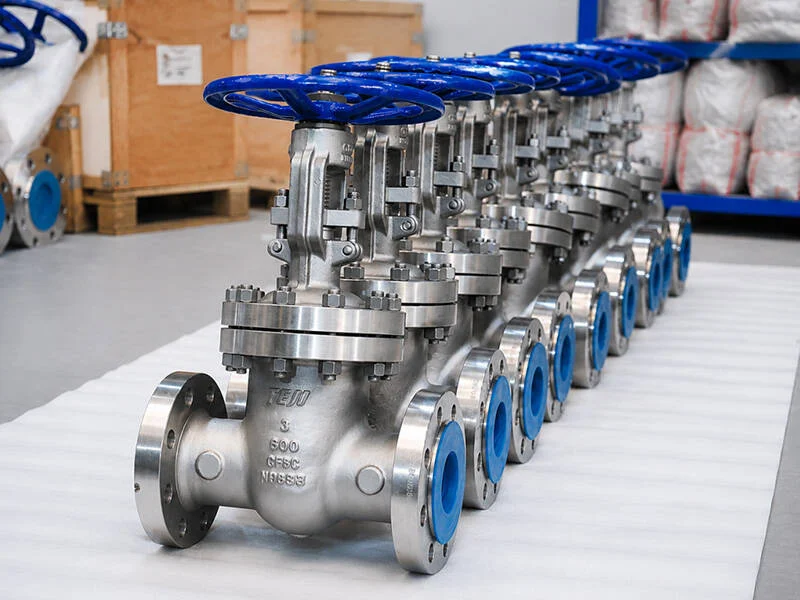
Installation of a Flanged Ball Valve
Preparation Before Ball Valve Installation
- The upstream and downstream pipelines should be coaxial, and the sealing surfaces of the two flanges should be parallel. The pipeline should be able to withstand the weight of the ball valve; otherwise, appropriate supports must be provided on the pipeline.
- Clean the pipelines before and after the valve, removing oil, welding slag, and all other impurities.
- Check the ball valve markings to ensure it is intact. Fully open and close the valve several times to verify its normal operation.
- Remove the protective fittings from the flanges connecting both ends of the ball valve.
- Inspect the valve bore and remove any possible contaminants, then clean the valve bore. Even small particles of foreign matter between the valve seat and the ball can damage the valve seat sealing surface.
Steps for Ball Valve Installation
- Install the ball valve onto the pipeline. Either end of the ball valve can be installed upstream. Hand-operated ball valves can be installed at any position on the pipeline. However, ball valves with gearboxes or pneumatic actuators should be installed vertically, i.e., on horizontal pipelines, with the actuator above the pipeline.
- Install gaskets between the valve flange and the pipeline flange according to the pipeline design requirements.
- Tighten the bolts on the flanges symmetrically, gradually, and evenly.
Ball Valve Installation Inspection
- Operate the actuator to open and close the ball valve several times; it should operate smoothly without any sticking, confirming normal operation.
- Check the sealing performance of the flange mating surfaces between the pipeline and the ball valve according to the pipeline design requirements.
Ball Valve Usage
- Disassembly and disassembly operations can only be performed after confirming that the pressure in the upstream and downstream pipelines of the ball valve has been released.
- Non-metallic parts should be removed from the cleaning agent immediately after cleaning and should not be soaked for a long time.
- During assembly, the bolts on the flanges must be tightened symmetrically, gradually, and evenly.
- The cleaning agent should be compatible with the rubber, plastic, and metal parts in the ball valve, as well as the working medium (e.g., natural gas). When the working medium is natural gas, gasoline (GB484-89) can be used to clean metal parts. Non-metallic parts should be cleaned with pure water or alcohol.
- Each disassembled individual ball valve part can be cleaned by immersion. Metal parts with remaining non-metallic components can be wiped with a clean, fine cloth soaked in detergent (to avoid fiber shedding and adhesion to the parts). During cleaning, all grease, dirt, adhesive residue, dust, etc., adhering to the wall surface must be removed.
- When disassembling and reassembling the ball valve, care must be taken to prevent damage to the sealing surfaces of the parts, especially non-metallic parts. A special tool should be used when removing O-rings.
- After cleaning, allow the cleaning agent on the cleaned wall surface to evaporate (it can be wiped with a cloth not soaked in detergent) before assembly. Do not leave it for extended periods, otherwise it will rust and become contaminated with dust.
- New parts must also be cleaned before assembly.
- Use grease for lubrication. The grease should be compatible with the ball valve’s metal materials, rubber parts, plastic parts, and the working medium. When the working medium is natural gas, a grease such as Special 221 can be used. Apply a thin layer of grease to the surface of the seal mounting groove, a thin layer of grease to the rubber seal, and a thin layer of grease to the sealing and friction surfaces of the valve stem.
- During assembly, metal shavings, fibers, grease (except for those specified), dust, and other impurities and foreign matter should not be allowed to contaminate, adhere to, or remain on the surface of the parts or enter the internal cavity.
TEJI Valve Group
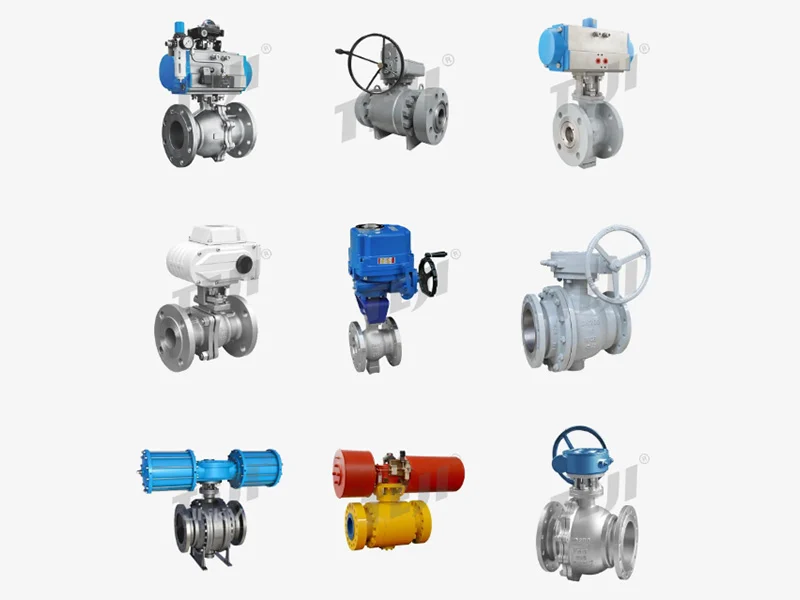
TEJI Valve Group specializes in the production of high, medium, and low-pressure industrial valves (gate valves, globe valves, check valves, ball valves, butterfly valves, regulating valves, control valves, etc.); cryogenic valves; water system valves (hydraulic control valves, gate valves, butterfly valves, pump control valves, air valves, semi-ball valves, rotary ball valves, piston valves, water hammer relief valves, gate valves, fire valves, and matching pipe fittings); special valve series (steam traps, oxygen valves, water cutters, breather valves, flame arresters, insulated valves, ceramic valves, diaphragm valves, spectacle valves, unloading valves, plug valves, diverting valves, etc.); marine valve series; water pumps; actuators, etc., totaling 36 major series of valve products. Nominal diameters range from DN15 to DN4000; nominal pressures range from PN0.06 to PN100; with over 300 varieties and over 2000 specifications.
The company boasts a wide range of valve diameters, pressure ratings, materials, and temperatures, offering a complete product portfolio, strong supporting capabilities, high cost-effectiveness, and long service life. These combined advantages place it at the forefront of the industry. The company is committed to providing the market with energy-saving, intelligent, environmentally friendly, safe, aesthetically pleasing, and durable products, along with worry-free service!