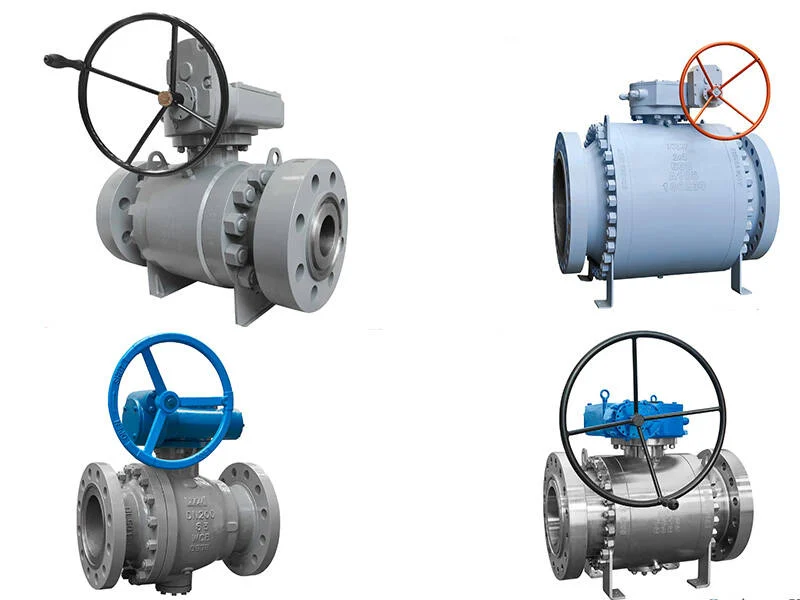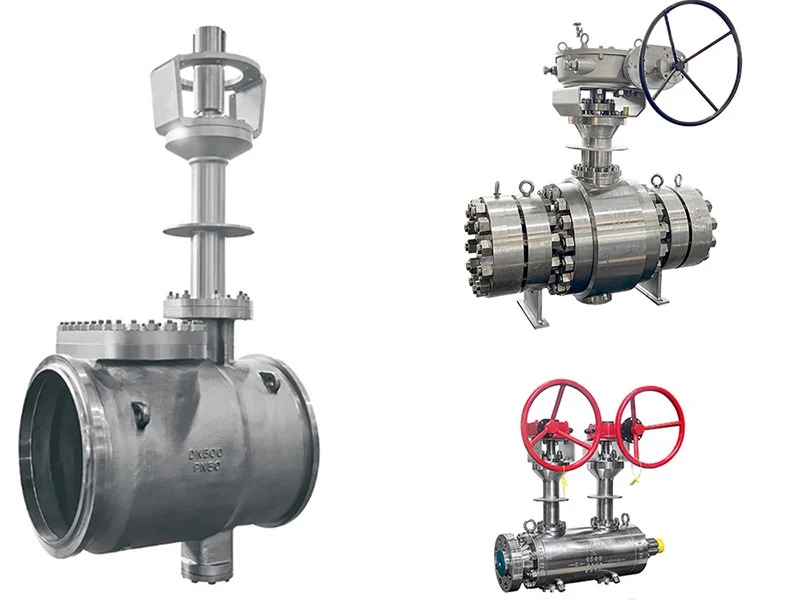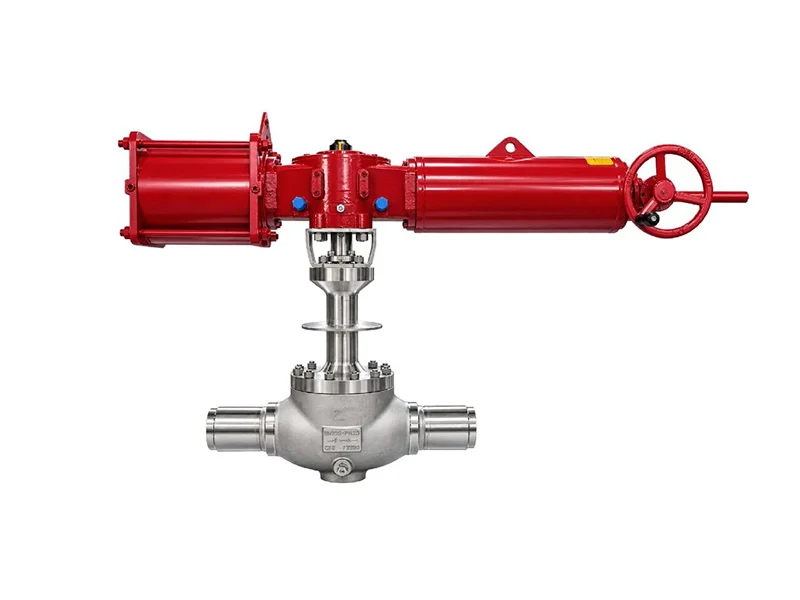
In critical cryogenic applications—such as the processing and transport of liquefied natural gas (LNG)—the selection of valves is a decision that significantly impacts both long-term economic efficiency and safety. While various types of cryogenic valves are suitable for low-temperature service, their structural differences dictate specific application suitability.
This article explores the distinctions between these valve types, using top-entry and side-entry cryogenic ball valves as a case study.
Top-Entry vs. Side-Entry: Structural Differences
The core distinction between top-entry and side-entry cryogenic ball valves lies in their structural design.
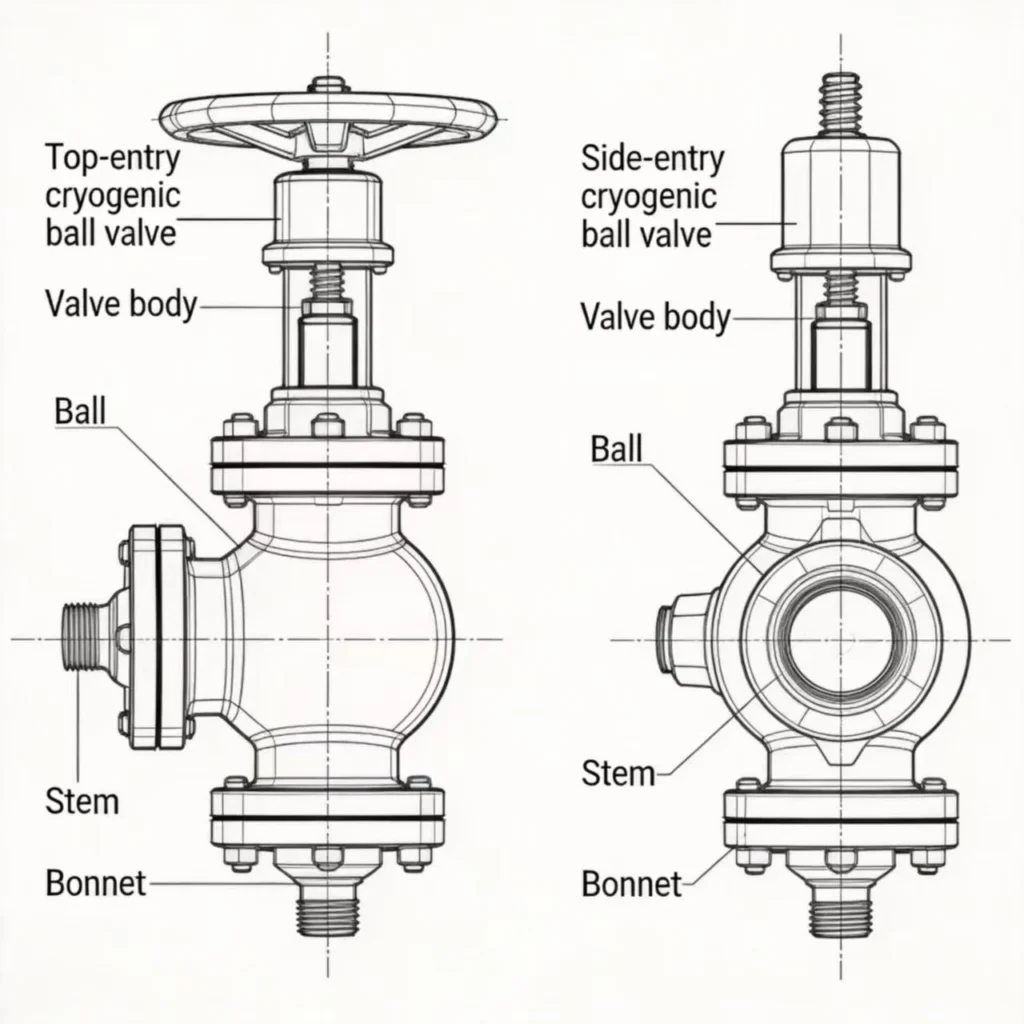
Top-Entry: These feature a one-piece forged or cast valve body with a removable bonnet located at the top. Unlike traditional side-entry ball valves, they lack a central split-flange joint. This design significantly reduces potential external leakage points and entirely eliminates the risk of seal failure caused by thermal expansion and contraction—a common issue with flanged connections in cryogenic service.
Side-Entry: These also utilize a one-piece forged or cast body, but with a lateral opening. Internal components—such as the ball and valve seats—are installed through this side opening, which is then sealed and secured using a side-mounted cover fastened with high-strength bolts.
Compared to the top-entry design, the side-entry configuration does not require a large opening at the top of the valve body, resulting in greater overall structural rigidity. Furthermore, it facilitates the integration of a fully enclosed insulation jacket around the valve body, making it well-suited for cryogenic processes involving viscous or crystallization-prone media.
Top-Entry vs. Side-Entry: Maintenance Differences
The most critical difference between these two designs is their “in-line maintainability.” In essential process facilities—such as those for LNG or hydrogen handling—even an hour of downtime can lead to substantial production losses and economic impact.
Top-Entry: Top-entry valves allow for isolation, depressurization, and maintenance to be performed in-situ (in place). Technicians can simply remove the bolts from the top bonnet, extract the stem/ball/seat assembly, replace wear parts (such as seals or gaskets), and then reinstall the bonnet. The entire process typically takes only a few hours.
Side-Entry: Side-entry valves must be completely removed from the pipeline. If the pipeline is welded, the valve must be cut out, transported to a workshop for repair, brought back to the site, and welded back into the line (a process that involves hot-work permits, pipeline purging, and X-ray inspection). This entire procedure can take several days.
Top-Entry vs. Side-Entry: Sealing Differences
Top-Entry: The integral valve body features only one potential external leakage point—at the top bonnet. It is less affected by thermal expansion and contraction stresses from the pipeline at cryogenic temperatures. When paired with a “lip-seal” (spring-energized seal), it can automatically compensate for sealing contact pressure during cryogenic contraction, offering higher long-term sealing reliability.
Side-Entry: These designs have multiple potential external leakage points, such as the body-bonnet flange and side covers. At cryogenic temperatures, differences in the thermal contraction coefficients of various materials can lead to seal failure. Furthermore, graphite-based seals are prone to cracking at low temperatures, resulting in a relatively higher risk of leakage.
Now that we understand the differences between these two types of valves, how should one choose?
Top-Entry: Best suited for LNG long-distance transmission pipelines, welded cryogenic piping, underground pipelines—where valve removal is difficult—and critical applications that demand minimal downtime.
Side-Entry: Better suited for small-bore applications, systems with insulation jackets (handling viscous or easily crystallized cryogenic media), and standard cryogenic pipelines where space is limited and frequent in-depth, in-line maintenance is not required.
In Conclusion
Studying the differences between valve types helps in selecting the most appropriate valve for your project. If you are unsure which valves to choose for your specific project, please feel free to contact us at any time.