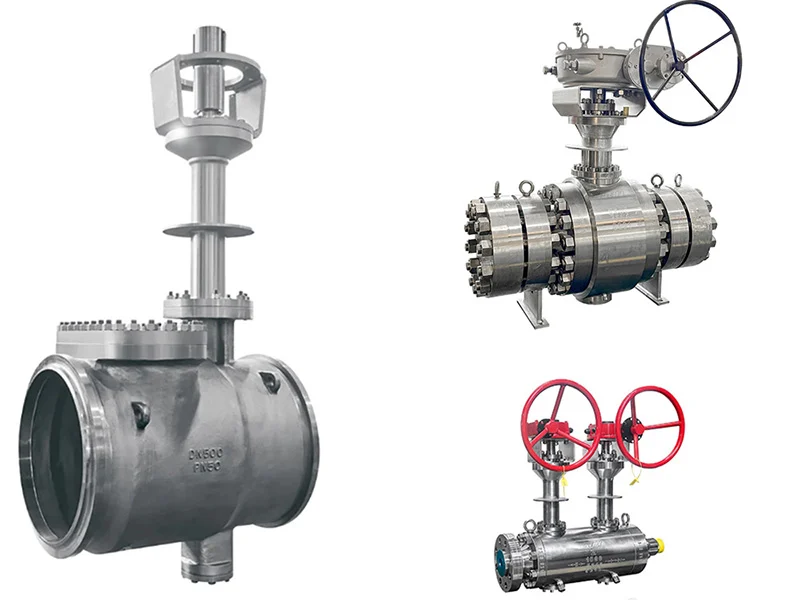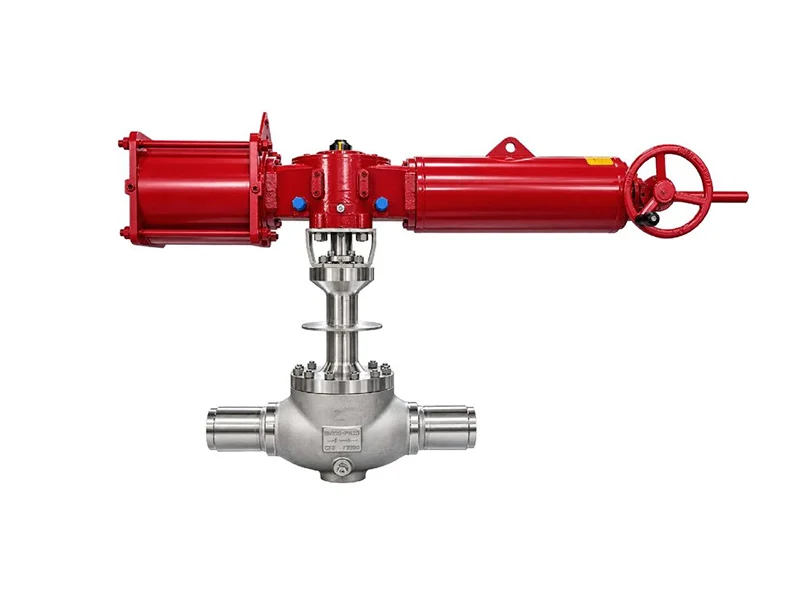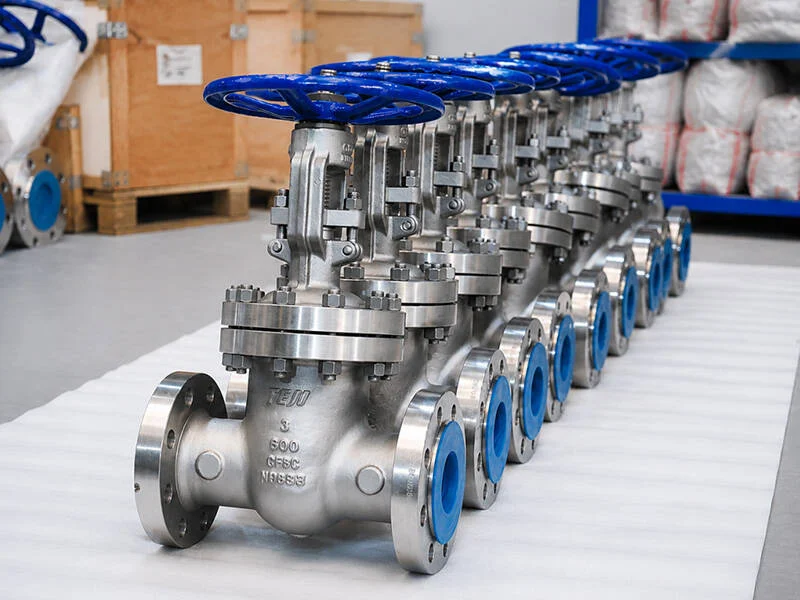
A plug valve is a rotary valve with a shut-off element or plunger-shaped valve. It opens or closes by rotating 90 degrees, allowing the passage on the plug to connect or separate from the passage on the valve body. When the through-hole on the plug aligns with the valve body passage, fluid flows smoothly; when the plug rotates and the through-hole misaligns with the valve body passage, the fluid is blocked.
Structural Features
• Plug Body: The opening and closing element of the plug valve. Its shape can be cylindrical or conical, and the passage is generally rectangular or trapezoidal, making the plug valve’s structure lightweight.
• Valve Body: The structure that houses and supports the plug body, usually connected to the piping system.
• Valve Stem: The component connecting the plug body and the operating handle or actuator, used to transmit operating force and drive the plug body to rotate.
• Sealing Elements: Including O-rings and PTFE bushings, using a double-grooved sealing ring structure to provide a seal and prevent media leakage.
Besides the difference in name, what are the essential differences between lubricated and non-lubricated plug valves, both of which are plug valves? Which one is more widely used? Let’s take a look.
Differences between Lubricated and Non-Lubricated Plug Valves
Structure and Sealing Methods
• Lubricated Plug Valve: A special lubricant is injected from the top of the plug into the space between the valve body’s conical orifice and the plug, forming an oil film. For example, an oil-lubricated hard-seal plug valve uses a sealing structure where the valve seat is lubricated by sealing grease. High-pressure sealing oil injected from the high-pressure nozzle forms a high-pressure sealing ring around the plug. An oil film exists between the valve body and the plug cone sealing surface, providing both sealing and lubrication.
• Non-Lubricated Plug Valve: Ordinary non-lubricated plug valves rely on direct contact between a precision-machined metal plug and the valve body for sealing. Small, packingless plug valves use this direct contact sealing method.
Performance Characteristics
Sealing Performance
• Lubricated Plug Valve: The oil film fills tiny gaps on the sealing surface, enhancing the sealing effect. Its working pressure can reach 64 MPa, meeting the sealing requirements under higher pressures.
• Non-lubricated Plug Valve: Sealing performance is relatively poor, typically only suitable for low-pressure (not exceeding 1 MPa) applications, as direct contact sealing cannot completely prevent media leakage.
Opening and Closing Torque
• Lubricated Plug Valve: The presence of an oil film significantly reduces friction during valve opening and closing, resulting in lower opening and closing torque and easier operation. Even under high pressure or large diameter conditions, the valve can be operated relatively easily.
• Non-Lubricated Plug Valve: Due to direct metal-to-metal contact, friction is higher, resulting in greater opening and closing force, especially under high pressure and large diameter conditions, making operation difficult.
Service Life
• Lubricated Plug Valve: The lubricating and protective effects of grease reduce wear on the sealing surfaces, extending the valve’s service life. For example, welding STL alloy material or using surface hardening technology on the plug cone sealing area, combined with grease, enhances the wear resistance and corrosion resistance of the sealing surface.
• Non-Lubricated Plug Valve: Frequent opening and closing operations accelerate wear on the sealing surfaces, leading to a shorter valve service life.
Having looked at the differences between lubricated and non-lubricated plug valves, it seems that lubricated plug valves are indeed more practical than non-lubricated plug valves. So, can lubricated plug valves replace non-lubricated plug valves? And can non-lubricated plug valves really be phased out? Let’s continue reading with these questions in mind.
Can a lubricated plug valve replace a non-lubricated plug valve?
Lubricated plug valves require regular grease injection; otherwise, their sealing performance will rapidly decline. Non-lubricated plug valves, on the other hand, are essentially maintenance-free and suitable for unattended or inaccessible pipelines. In high-pressure, high-wear, particle-containing, or high-temperature (≤325℃) applications, lubricated plug valves perform better and significantly extend valve life. For clean media, low-pressure applications, or applications requiring protection from any external contamination (such as drinking water or food-grade pipelines), non-lubricated plug valves are safer. Lubricated and non-lubricated plug valves each have their own applicable scenarios, and one cannot simply replace the other entirely.
Applications of Non-Lubricated Plug Valves
Chemical and Petrochemical Industry: Used to control the flow of various corrosive media, such as in acid and alkali solution pipelines, to achieve media cut-off and connection.
Food, Beverage, and Pharmaceutical Industry: Can prevent lubricants from contaminating food and beverages. For example, in dairy processing and beverage bottling lines, used for fluid control in material conveying pipelines to ensure product quality and safety.
General Industrial and Civil Applications: In some general industrial facilities, non-lubricated plug valves are widely used for low-pressure, small-diameter fluid control needs due to their simple structure and low cost.
Electronics and Semiconductor Industry: Non-lubricated plug valves, with their special materials and design, can meet the control requirements of high-purity media, ensuring the stability of the production process and product quality.
As mentioned above, both lubricated and non-lubricated plug valves are irreplaceable and play important roles in various fields. If you are looking for a suitable valve manufacturer, TEJI would be a good choice.