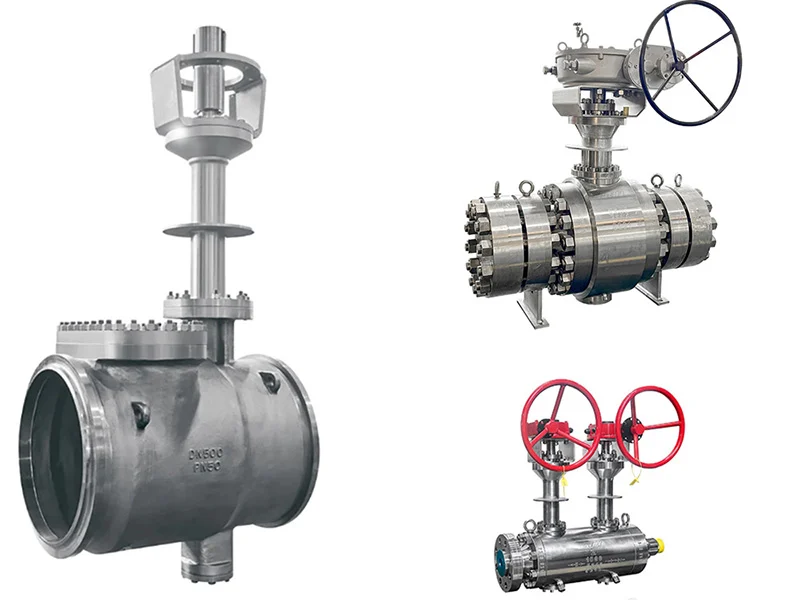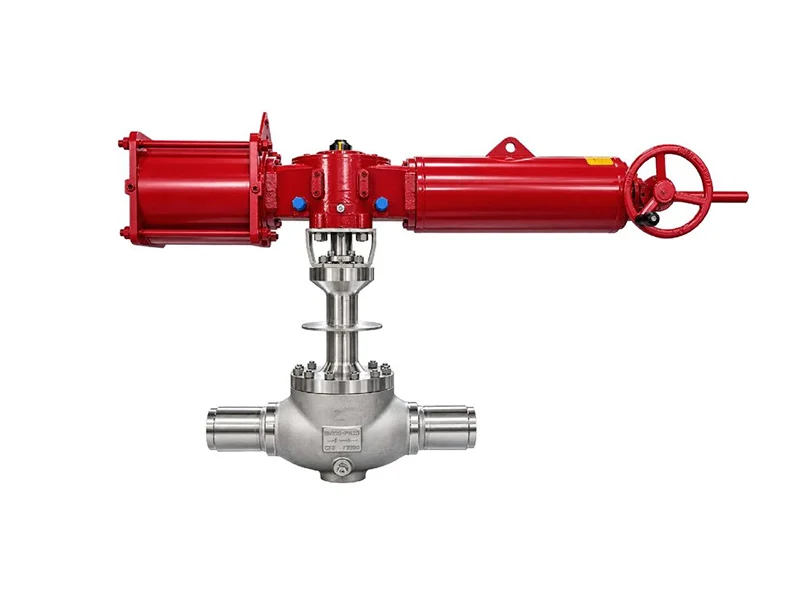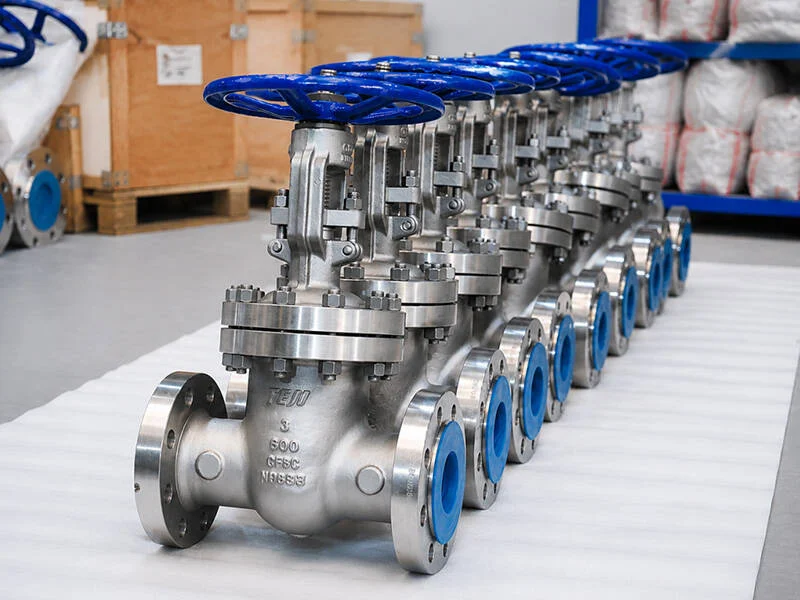
Forged steel valves are industrial valves manufactured using a forging process and are widely used in piping systems in thermal power plants, the petroleum industry, and the chemical industry. Their core components are made of carbon steel, stainless steel, or alloy steel through high-temperature forging, resulting in high strength, high-temperature, high-pressure, and shock resistance. They can operate at nominal pressures up to 4500 lb (76.0 MPa).
Forged steel valves come in a variety of types, including gate valves, globe valves, check valves, and ball valves. The sealing surfaces are often welded with carbide overlay technology, and the valve stems are nitrided for improved corrosion resistance. They can also be adapted for electric and pneumatic actuation to meet remote control requirements.
Cast steel valves are made of cast steel and are widely used in the petroleum industry, the chemical industry, and the power industry. They offer high strength and toughness, can withstand high pressures and temperatures, and are highly resistant to shock and corrosion. During daily use, cast steel valves should be regularly inspected for proper opening and closing, leaks, and internal and external surfaces. Lubricate moving parts to ensure smooth operation. Inspect seals and replace if necessary to ensure proper valve operation and extend their lifespan.
After reading the above introduction to forged and cast steel valves, it’s still unclear what the differences are, or which type is more suitable for your application. Don’t worry, let’s take a look at a table.
| Dimensions | Forged steel valves | Cast steel valves |
| Manufacturing process | The metal billet is forged at high temperature to refine the grains and make the structure dense. | Molten steel is poured into the mold, which has a simple process and can produce complex structures, but may have defects such as pores and shrinkage. |
| Material properties | It has better strength, toughness, impact resistance, high pressure resistance and fatigue resistance. | Strength and toughness are relatively low, but properties can be improved through alloying. |
| Applicable working conditions | High temperature and high pressure (such as the main steam pipeline of a power plant) and frequent opening and closing scenarios. | Medium and low pressure (such as municipal water supply), large diameter or complex structure scenarios. |
| Cost | The manufacturing cost is high, and the mold cost accounts for a large proportion. | The cost is low and suitable for mass production. |
| Specification limits | Mostly used for small diameter (DN≤200) with uniform wall thickness. | Large diameter (DN300 and above) can be manufactured, and the wall thickness can be uneven. |
| Sealing | The valve seat has high fitting precision and long-term stable sealing. | It needs to rely on seals for compensation, and the sealing risk is slightly higher under high pressure. |
The table above shows that forged steel valves are preferred for high-pressure, high-temperature, and critical pipelines. For medium- and low-pressure, large-diameter, and cost-sensitive applications, cast steel valves are preferred. If you’re still undecided, let’s further analyze the unique advantages and disadvantages of forged and cast steel valves and discuss how to choose between them.
Advantages and Disadvantages of Forged Steel Valves Compared to Cast Steel Valves
Advantages
- Excellent Mechanical Properties: Forged steel valves undergo plastic deformation during forging, resulting in grain refinement and elimination of defects such as as-cast porosity and pores. They offer high density and significantly higher physical properties, including strength, plasticity, toughness, and compressive strength, than cast steel valves. They can withstand greater impact forces and are suitable for piping systems with high pressure, high temperature, and corrosive media.
- Uniform Structure: The forging process imparts a well-defined grain structure to the material, resulting in valves with consistent shape and uniform structure, providing more stable performance.
- High Dimensional Accuracy: Forgings offer high dimensional accuracy, allowing for direct use, reducing subsequent processing.
- High Pressure Rating: Common pressure ratings include PN100, PN160, PN320, and 1500lb – 3500lb, meeting the needs of higher pressure applications.
Disadvantages
- High Manufacturing Cost: The heavy industrial molds and other equipment used in forging are more expensive, and the forging process is demanding, resulting in higher costs for forged steel valves than cast steel valves.
- Limited Size: Generally, the nominal diameter is smaller, mostly below DN50. Forging heavier materials requires higher power. When the material weight exceeds 50 kg, casting may be a more suitable alternative.
- Single Shape: The focus is on producing uniform and simple materials, making complex patterns and shapes difficult to manufacture.
Advantages and Disadvantages of Cast Steel Valves Compared to Forged Steel Valves
Advantages
- Low Cost: The mold costs and processing time of the casting process are much lower than forged steel. The price of forged steel valves of the same diameter is approximately 50%-70% of that of forged steel.
- Large Diameters and Complex Structures: They can be cast in a single pass, supporting large diameters (DN300 and above) and complex flow path designs, while forged steel is generally limited to sizes below DN200.
- Wide Range of Applicable Media: They are more resistant to impure media (such as industrial water and low-viscosity solutions) than forged steel, as their cast structure can withstand minor erosion.
Disadvantages
- Lower mechanical properties: Indicators such as tensile strength and impact toughness are lower than forged steel, making them less able to withstand high pressures, high-frequency shocks, and drastic temperature fluctuations.
- Risk of Internal Defects: Defects such as porosity and shrinkage may occur, reducing sealing reliability and making leakage more likely under high-pressure conditions.
- Short Maintenance Cycle: Seals require more frequent replacement, resulting in higher long-term operating costs than forged steel.
In short, cast steel valves excel at cost-effectiveness and structural flexibility, but at the expense of performance and reliability. Forged steel valves offer high performance and long life, but at a higher cost.
Through the above analysis, we believe you have a clearer understanding of forged and cast steel valves. If you need to purchase valves, please feel free to contact us. TEJI will always provide you with high-quality valves.